中文简体
中文简体 English
 日本語
日本語 русский
 Español
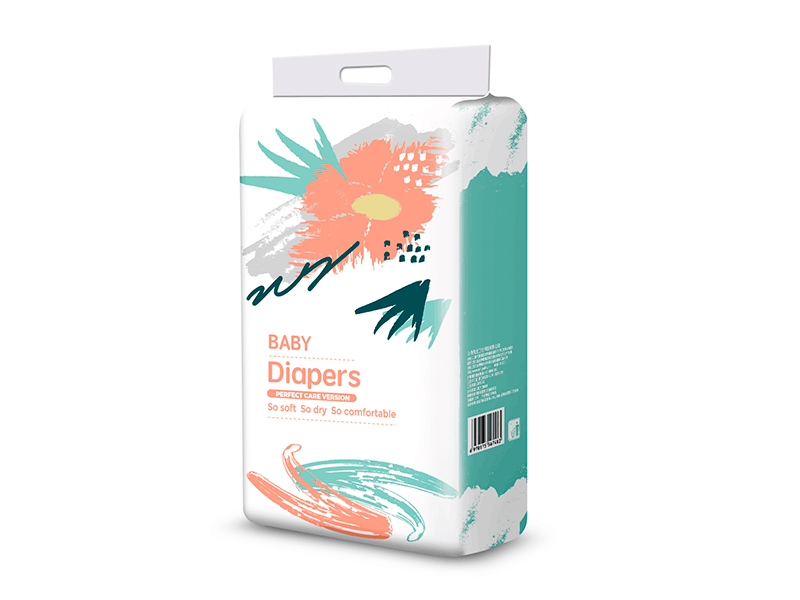
Modern parents expect a baby diaper to do more than simply absorb liquid. They want fast intake, dependable dryness, gentle skin contact, secure leak protection, an easy fastening experience, and consistent performance from one diaper to the next. Absorbent baby diapers in the premium diaper category are designed around these expectations, combining rapid suction structures, water-locking absorbent layers, full-length diversion grooves, raised leak barriers, a soft elastic back waist, and a widened non-adhesive magic buckle for safer and more convenient daily use.
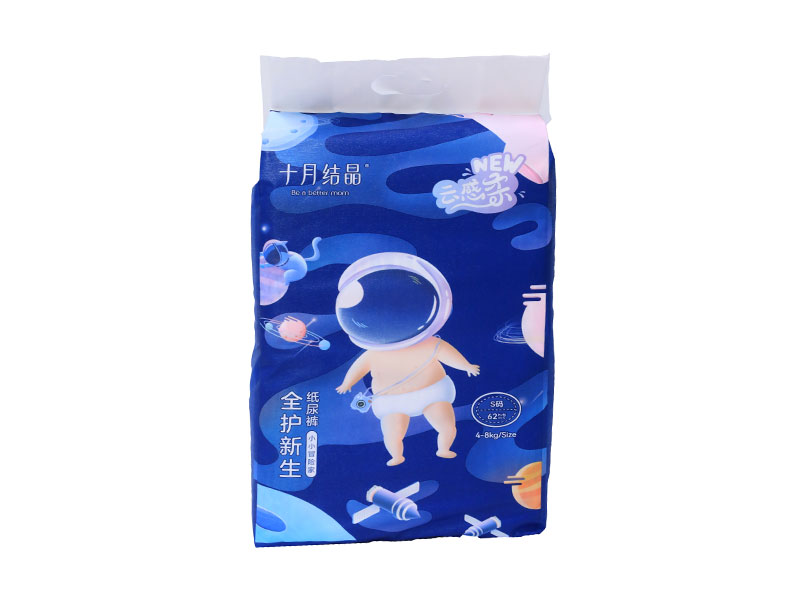
Baby diapers are among the most frequently used baby care products in the world. A newborn or infant may require multiple diaper changes each day, which means parents quickly notice the difference between an ordinary diaper and a diaper designed for stable comfort. A premium diaper must stay dry after repeated wetting, fit the baby’s body without excessive pressure, resist side leakage during crawling or sleeping, and remain easy for caregivers to put on correctly. The product discussed here is positioned to meet these needs through a structure that emphasizes fast suction, no leakage, dryness, and worry-free use.
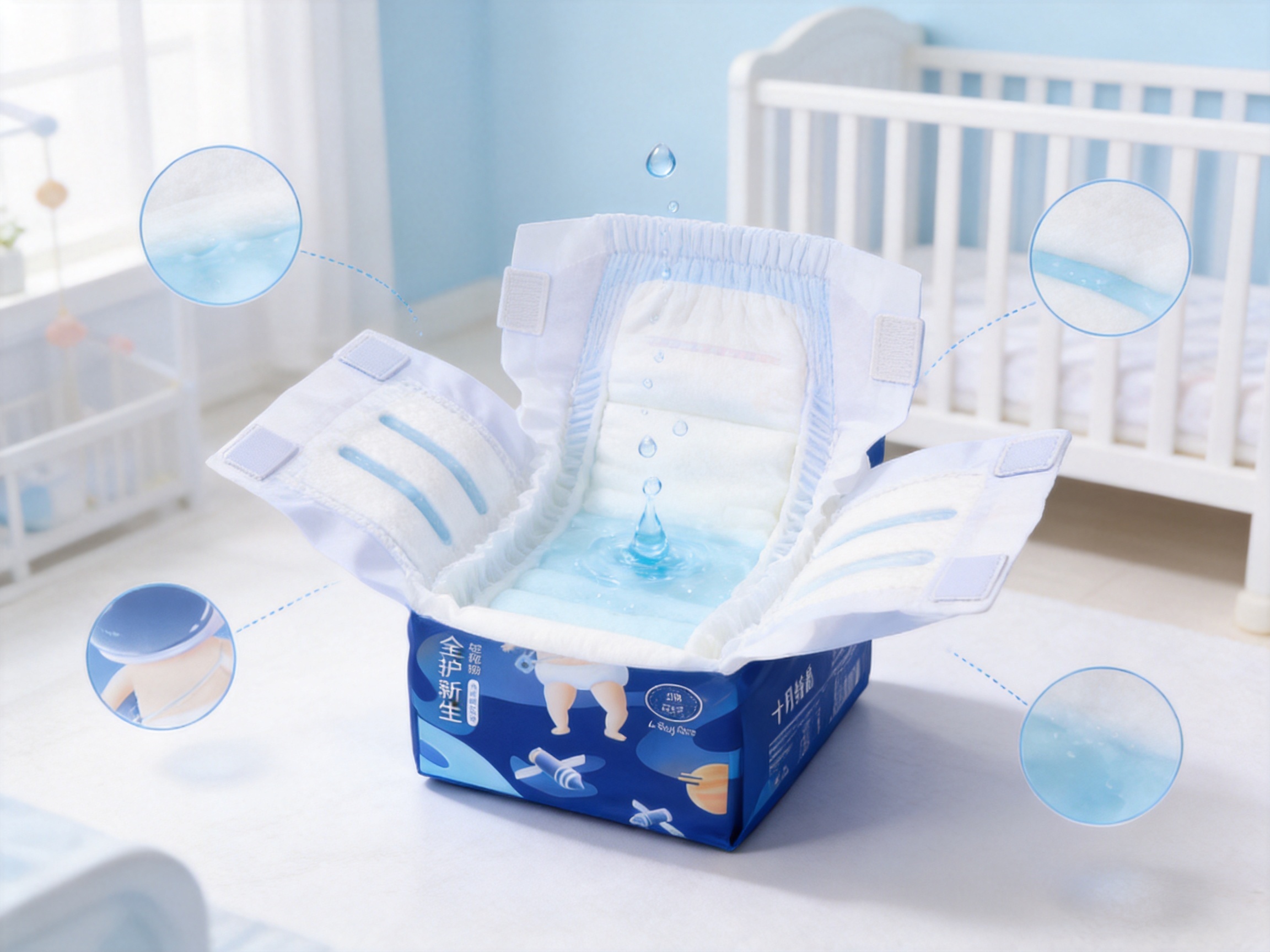
The product’s core design includes three layers for fast suction and liquid locking. This layered construction helps urine pass quickly away from the baby’s skin and into the absorbent core, where it is retained. In addition, three full-length diversion grooves distribute liquid more evenly along the diaper body, reducing the chance of local saturation. Heightened double three-dimensional leak-proof partitions add side protection, especially when the baby is lying down or moving actively. A soft elastic back waist improves fit around the waist and helps reduce gaps, while the widened and long soft non-adhesive magic buckle supports convenient adjustment during fastening.
Behind a diaper’s comfort is a highly controlled manufacturing system. Zhejiang Uniquality Nursing Products Technology Co., Ltd., together with the industrial foundation of Kingsafe, brings decades of nonwoven material expertise into baby care products. Founded in 1987, the group has developed into a national high-tech enterprise specializing in research, development, production, and sales of medical and hygienic nonwoven materials, nursing products, and high-end clothing interlining. This background gives the diaper product a significant advantage: the company understands not only how to assemble diapers, but also how to engineer the nonwoven layers that determine softness, breathability, absorption transfer, strength, and skin feel.
Understanding the Needs of Modern Baby Diaper Users
Parents usually evaluate diapers according to practical, everyday criteria. The first is absorption speed. If liquid stays on the surface too long, the baby may feel damp, and the caregiver may need to change the diaper more frequently. The second is dryness. A diaper may absorb a large amount of liquid, but if the surface remains wet after absorption, it does not deliver premium comfort. The third is leakage control. Leakage can interrupt sleep, dirty clothing, and create extra laundry. The fourth is fit. A diaper that is too loose may leak, while a diaper that is too tight may leave marks or restrict movement. The fifth is ease of use. Parents appreciate fastening systems that can be adjusted smoothly, especially during nighttime changes or when the baby is active.
Absorbent baby diapers in this category are engineered around these daily realities. The phrase “fast suction, no leakage, dry and worry-free” reflects a practical value proposition rather than a decorative slogan. Fast suction helps reduce wet contact time. Leak prevention improves confidence during sleep, travel, and movement. Dryness supports comfort between changes. A secure yet gentle fit makes the diaper easier for parents to trust. When these elements work together, the diaper becomes more than a disposable hygiene product; it becomes part of a reliable baby care routine.
Three-Layer Fast Suction and Water-Locking Structure
The three-layer fast suction and water-locking body is one of the most important features of the product. In a high-quality diaper, liquid management is not handled by a single layer. Instead, several layers work together. The top surface should feel soft and allow quick penetration. The acquisition and distribution layer should guide liquid away from the surface and spread it efficiently. The absorbent core should lock liquid and reduce rewet. A well-designed three-layer system balances speed, distribution, and retention.
Compared with lower-cost diapers that may rely on a less refined absorbent structure, this layered approach provides a more controlled absorption pathway. In an ordinary diaper, liquid may collect in one region, especially in the central area, leading to swelling, clumping, or localized leakage. By using fast suction layers and a water-locking body, the diaper helps move urine away from the skin quickly and hold it inside the core. This is especially useful during nighttime use, when long intervals between changes require dependable absorption and reduced surface dampness.
The water-locking effect also matters during baby movement. Babies do not remain still. They kick, roll, crawl, sit, and sleep in different positions. A diaper must retain absorbed liquid even when pressure is applied by the baby’s body. A high-performance absorbent core aims to reduce liquid returning to the surface under pressure. This is commonly known as rewet control, and it is a major factor in perceived dryness. The three-layer structure contributes to the diaper’s ability to provide a dry and worry-free wearing experience.
Full-Length Diversion Grooves for Even Liquid Distribution
The product includes three full-length diversion grooves. These grooves are more than visual design details. They help guide liquid along the length of the absorbent area, improving distribution and reducing the burden on a single absorption zone. When liquid is spread more evenly, the absorbent core can be used more efficiently. This can help prevent sagging, reduce the risk of leakage, and maintain a more comfortable diaper shape after wetting.
In many competing diapers, insufficient distribution may cause uneven swelling. A diaper may become bulky in one area while other areas remain underused. This unevenness can affect fit and comfort, especially when the baby is crawling or sleeping. Full-length diversion grooves help address this issue by creating channels that encourage liquid to travel and disperse. As a result, the diaper can maintain a more balanced form and offer improved protection over a longer wearing period.
The presence of three grooves also supports stability. A single channel may not distribute liquid effectively under all body positions. Multiple full-length grooves help guide absorption across the diaper body and reduce the likelihood of liquid pooling. For parents, this means greater peace of mind during active daytime use and overnight rest. For babies, it means a diaper that can remain more stable, less bulky in one spot, and more comfortable during movement.
Heightened Double Three-Dimensional Leak-Proof Partitions
Leak protection is one of the most visible performance differences between premium and ordinary diapers. A diaper can have a strong absorbent core, but if liquid escapes from the sides before it is absorbed, the core’s capacity becomes less meaningful. The heightened double three-dimensional leak-proof partitions are designed to create an additional barrier along the leg area. These raised partitions help contain liquid and soft stool, giving the absorbent structure more time to work.
Three-dimensional leak barriers are particularly important for babies who move frequently. When a baby kicks or turns, gaps can open around the thighs if the diaper does not fit properly. Raised partitions help reduce the risk of side leakage by standing up along the diaper edges. The double design provides an enhanced containment structure compared with simpler single-barrier diapers. This contributes to the product’s “no leakage” advantage and supports confidence during travel, naps, and nighttime use.
Comfort is equally important. Leak barriers must protect without scratching or pressing harshly against the skin. The product’s design combines leak prevention with soft materials so that containment does not come at the expense of comfort. This is where manufacturing quality and material selection become essential. A leak barrier that is too stiff may irritate the baby, while one that is too weak may collapse during use. A well-balanced three-dimensional partition remains gentle yet functional.
Soft Elastic Back Waist for Better Fit
The soft elastic back waist improves the diaper’s ability to adapt to a baby’s body shape. Babies have rounded bellies and soft waistlines, and their body position changes throughout the day. A rigid waist structure may create gaps when the baby bends or lies down. A soft elastic back waist helps maintain contact with the body, reducing rear leakage and improving overall fit.
This feature is especially valuable during sleep. Babies often lie on their backs for long periods. If the back waist is not secure, liquid may travel toward the rear and escape. The elastic back waist helps close this potential leakage path while remaining soft enough for comfortable wear. It also supports a more flexible fit during movement, making the diaper suitable for active babies as well as sleeping infants.
Compared with competitors that use basic waist designs, a soft elastic back waist can offer a more premium wearing experience. It helps parents fasten the diaper with confidence and reduces the need for repeated adjustment. It also supports the diaper’s ability to stay in position, which is essential for absorption performance. Even the best absorbent core cannot work properly if the diaper shifts too much during use.
Widened and Long Soft Non-Adhesive Magic Buckle
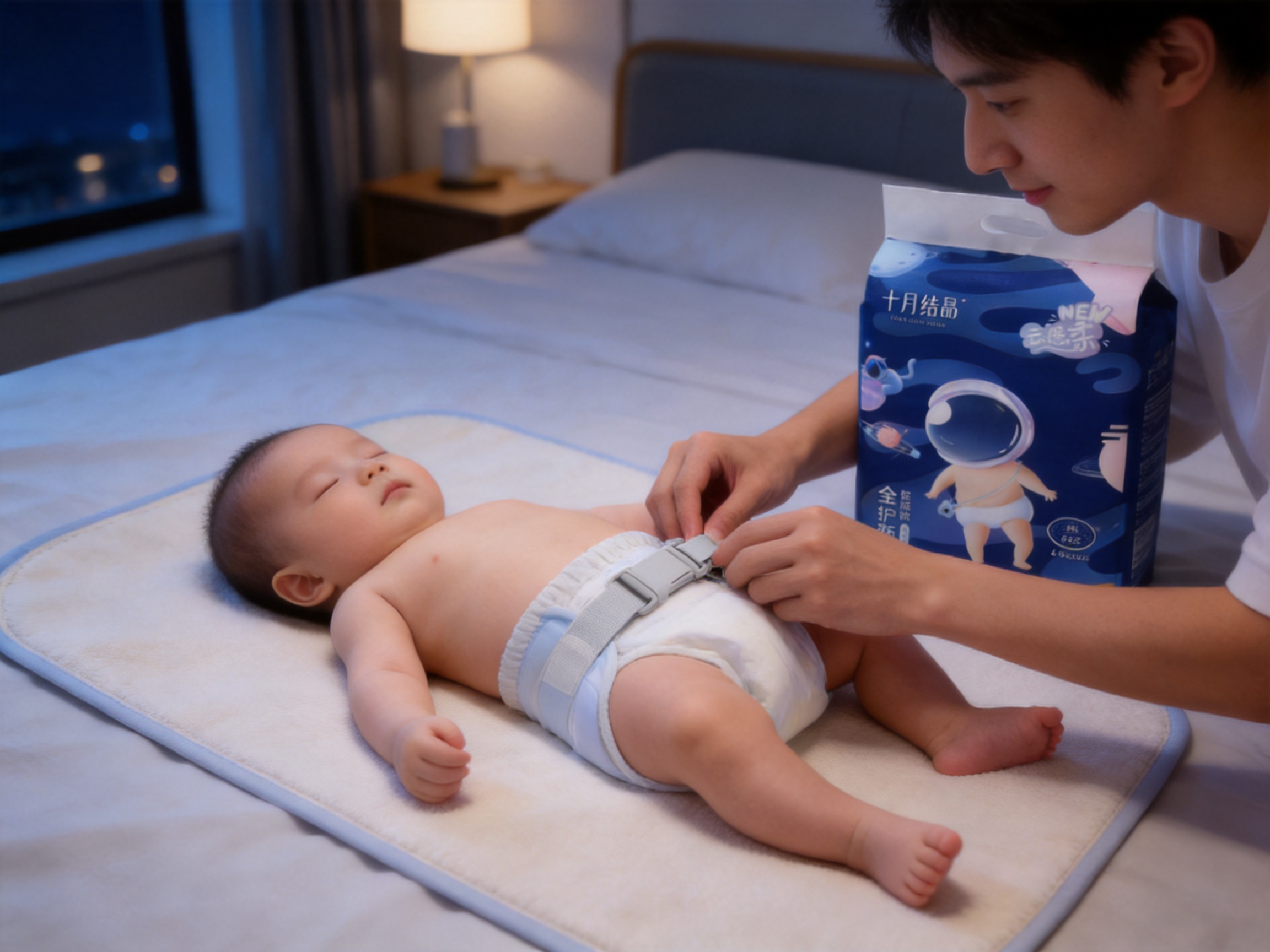
The fastening system is another detail that affects user satisfaction. The product adopts a widened and long soft non-adhesive magic buckle. This design is safer and more convenient to use because it supports stable fastening without relying on harsh adhesive contact. The wider and longer buckle area allows caregivers to adjust the diaper more easily, helping achieve a secure fit around the waist.
A high-quality fastening system should be strong enough to stay closed, soft enough to avoid discomfort, and adjustable enough to fit different baby body shapes. Some low-end diapers may use fasteners that are narrow, rough, or difficult to reposition. This can lead to improper fit, wasted diapers, or discomfort. The soft non-adhesive magic buckle provides a more user-friendly experience, particularly for caregivers who need to change diapers quickly.
Convenience matters because diaper changing is repeated many times every day. A fastening system that works smoothly reduces stress for parents and helps keep the baby comfortable. The widened design also helps distribute fastening tension more evenly, reducing the chance of localized pressure. This contributes to a better balance between secure fit and gentle wear.
Product Feature Overview
| Product Element | Functional Purpose | Advantage for Parents and Babies |
|---|---|---|
| Three-layer fast suction body | Moves liquid quickly away from the surface | Helps maintain dryness and reduces wet contact |
| Water-locking absorbent structure | Retains absorbed liquid inside the core | Supports longer-lasting comfort and reduced rewet |
| Three full-length diversion grooves | Distributes liquid along the diaper body | Improves core utilization and helps prevent local saturation |
| Heightened double three-dimensional leak-proof partitions | Creates raised side barriers | Reduces side leakage during movement and sleep |
| Soft elastic back waist | Improves waist fit and reduces rear gaps | Enhances comfort and leakage protection |
| Widened long soft non-adhesive magic buckle | Supports easy, adjustable fastening | Improves convenience, safety, and fit control |
Advantages Over Ordinary Competing Diapers
The diaper market includes many products that look similar at first glance. However, performance differences become clear during real use. Ordinary diapers may absorb slowly, feel wet after urination, leak at the legs, become bulky in the center, or use fastening materials that are less comfortable. The absorbent baby diaper described here addresses these common pain points with an integrated design: fast suction layers, liquid diversion grooves, leak-proof partitions, elastic waist support, and a soft adjustable buckle.
One advantage is more efficient liquid handling. Competitors that use basic cores may absorb, but they may not distribute liquid evenly or reduce rewet effectively. The three-layer suction and water-locking body, combined with full-length diversion grooves, improves the diaper’s ability to manage liquid dynamically. This is important because diaper performance is not measured only by total capacity. A premium diaper must absorb quickly, spread liquid properly, lock it away, and remain comfortable under pressure.
Another advantage is improved leakage control. The heightened double three-dimensional leak-proof partitions provide stronger side containment than simpler flat-edge designs. This is particularly important for babies with active legs or for overnight use when the diaper must perform in different sleeping positions. The soft elastic back waist also helps reduce rear leakage, which is a common complaint among parents using less advanced diapers.
A third advantage is user convenience. The widened and long soft non-adhesive magic buckle makes fastening easier and more reliable. Caregivers can adjust the diaper with less difficulty, helping create a better fit. An easy fastening system may seem like a small feature, but it strongly affects everyday satisfaction. A diaper that fits correctly is less likely to leak and more likely to feel comfortable.
Finally, the product benefits from the company’s integrated manufacturing and nonwoven material expertise. Many diaper suppliers rely heavily on purchased materials and limited assembly control. In contrast, a company with deep experience in spunlace nonwoven fabrics, spunmelt nonwoven fabrics, hot air through nonwoven fabrics, flushable and degradable nonwoven materials, wet wipes, dry wipes, diapers, pull-ups, and other hygiene products can better control material quality and product consistency. This gives the diaper a structural advantage over competitors whose production systems may be less integrated.
Manufacturing Strength Built on Nonwoven Expertise
A baby diaper is a complex nonwoven-based hygiene product. Its performance depends on the quality of multiple materials, including the topsheet, acquisition layer, absorbent core components, backsheet, leg cuffs, waist materials, and fastening system. The company behind this product has a long history in nonwoven materials and nursing products. Founded in 1987, it has grown through research, production, and sales of medical and hygienic nonwoven materials, nursing products, and high-end clothing interlining.
This history matters because nonwoven technology is central to diaper quality. The softness of the surface, the strength of the leak guards, the breathability of the layers, and the consistency of production all depend on material science and process control. Experience with spunlace, spunmelt, hot air through, flushable, and degradable nonwoven materials allows the manufacturer to understand how fiber selection, web formation, bonding method, and finishing influence final product performance.
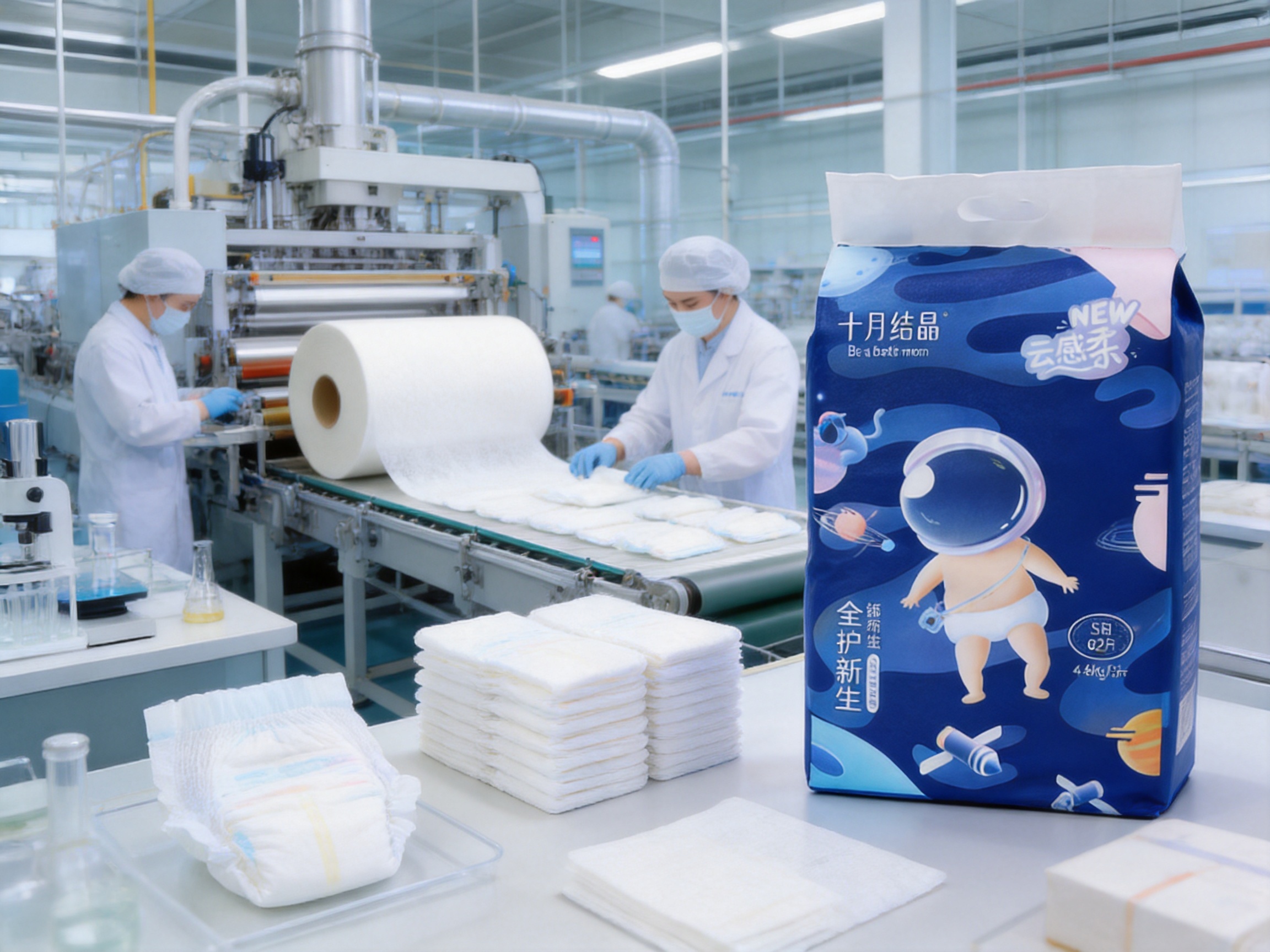
The company has also introduced advanced production equipment and technology from Germany, France, and Italy. Internationally advanced equipment supports precision, efficiency, and consistency. In diaper manufacturing, small differences in material placement, core distribution, elastic tension, or fastening alignment can affect performance. Advanced machinery helps reduce these variations, ensuring that each diaper meets the intended design standard.
Large-scale manufacturing strength also supports supply stability. The group has established multiple production bases in China, including locations in Guangdong, Jiangsu, Hubei, and Zhejiang. This production network helps serve domestic and international customers with greater flexibility. For private label customers, brand owners, and distributors, stable supply and consistent quality are just as important as product design. A strong manufacturing platform allows the company to support customization while maintaining reliable output.
Research, Development, and Customization Capabilities
The baby care market changes quickly. Parents increasingly ask for softer materials, better breathability, more skin-friendly structures, thinner yet more absorbent cores, improved environmental responsibility, and attractive packaging. A manufacturer must therefore do more than produce a fixed product. It must have research and development capabilities that allow product improvement and customization.
The company is able to meet the needs of differentiation, functionalization, and customization for customers. This is especially important for OEM and ODM partners. A private label diaper brand may require a specific absorbency level, size range, packaging design, material hand feel, market positioning, or cost structure. With strong nonwoven knowledge and diaper manufacturing capability, the company can help customers develop products that match their target markets.
Customization can include surface softness, absorbent core composition, waist elasticity, side tape structure, printed backsheet design, packaging quantity, and product size specifications. It can also include performance positioning, such as diapers optimized for daytime use, nighttime use, high mobility, or premium softness. The ability to customize gives brand owners more freedom to compete in different market segments.
For consumers, R&D strength appears in the final wearing experience. A diaper that feels soft, absorbs quickly, resists leakage, and fits well is the result of repeated design testing and process improvement. For business customers, R&D strength reduces development risk and helps bring products to market more efficiently. The company’s long-term cooperation with many well-known brands domestically and internationally also reflects its ability to meet professional quality expectations.
Quality Control Throughout the Diaper Production Process
Premium diaper manufacturing requires strict quality control at every stage. Raw materials must be inspected for softness, tensile strength, hygiene, absorbency, and consistency. During production, machines must control layer alignment, core placement, elastic tension, cutting accuracy, sealing strength, and fastening position. Finished products must be checked for appearance, dimensions, absorbency performance, leakage resistance, and packaging quality.
Quality control begins before production starts. Nonwoven fabrics and absorbent materials must meet specified standards. Materials that vary too much can lead to inconsistent diapers. For example, if the topsheet is not uniformly permeable, liquid intake may slow down. If the absorbent core distribution is uneven, the diaper may swell irregularly. If elastic materials are inconsistent, the fit may vary from one diaper to another. A strong manufacturer controls these inputs carefully.
During production, advanced equipment helps maintain precision. Diaper production lines run at high speed, so automated monitoring and process stability are essential. Correct placement of diversion grooves, leak-proof partitions, and fastening components must be maintained continuously. Any misalignment can affect performance or comfort. Skilled operators and technical teams monitor production to reduce defects and ensure consistent output.
Finished product inspection completes the quality system. Diapers may be tested for absorption speed, retention, rewet, leakage resistance, and fastening strength. Packaging must also protect hygiene and prevent damage during transport. For export and private label business, stable quality control supports customer trust and repeat cooperation. Parents may not see the production process, but they experience its results every time the diaper performs reliably.
Comfort, Skin Contact, and Daily Wearability
A baby’s skin is delicate, so diaper comfort is essential. While absorbency and leak control are important, the diaper must also feel gentle during long wear. Soft surface materials help reduce friction. A dry surface helps reduce damp discomfort. A flexible waist and leg area help the diaper move with the baby. Smooth fastening materials help prevent scratching or pressure.
The product’s soft elastic back waist and soft non-adhesive magic buckle contribute directly to daily wearability. The elastic back waist helps the diaper follow body movement, while the buckle allows caregivers to adjust fit without using uncomfortable adhesive contact. This is especially helpful when babies are active during changes or when parents need to refasten the diaper for better positioning.
Breathability is another factor in comfort. Although the provided product description emphasizes absorption and leakage protection, the manufacturer’s deep experience in hygienic nonwoven materials supports the development of breathable and comfortable diaper structures. A breathable diaper can help reduce stuffiness and improve the overall wearing experience. Material selection and layer design are important for balancing breathability with leakage resistance.
Daily wearability also depends on shape stability. If a diaper becomes heavy, saggy, or uneven after wetting, the baby may feel restricted. The three full-length diversion grooves help distribute liquid and reduce local swelling, supporting a more stable shape. This is important for crawling, standing, playing, and sleeping. A diaper that stays in place and maintains balanced absorption allows babies to move more freely.
Why Integrated Production Benefits Private Label Customers
Private label customers need more than a manufacturer; they need a reliable development and production partner. In the diaper business, brand reputation depends on product consistency. If consumers experience leakage, rough materials, or unreliable fastening, they may not purchase the brand again. Therefore, private label partners must select factories with strong material knowledge, production capacity, quality control, and customization capability.
Zhejiang Uniquality Nursing Products Technology Co., Ltd. is positioned as a manufacturer and factory for private label wipes, baby diapers, growing training pants, wet and dry wipes, and related hygiene products. This multi-category capability is valuable for brand owners who want to build a complete baby care or personal care portfolio. A customer can develop diapers alongside wipes and other care products, improving product line coherence and supply chain efficiency.
The company’s roots in Kingsafe’s nonwoven industry platform offer another advantage. Ranking among leading enterprises in China’s industrial textile industry and being recognized among top nonwoven manufacturers globally reflects manufacturing maturity. For private label customers, this means the partner is not simply assembling products from unknown sources. It has a long industrial background, technical capabilities, and experience serving demanding markets.
Integrated production can also improve response speed. When a customer requests changes in softness, absorbency, packaging, or performance level, a manufacturer with material and product engineering knowledge can evaluate options more effectively. This reduces communication friction and helps transform market ideas into manufacturable products. For competitive diaper markets, faster and more reliable product development can be a major business advantage.
Applications and Usage Scenarios
Absorbent baby diapers are suitable for everyday infant care, including daytime wear, naps, nighttime sleep, outings, travel, and use during active play. The fast suction and water-locking structure helps manage repeated urination during normal use. The leak-proof partitions and elastic back waist provide added confidence when the baby changes position or sleeps for extended periods.
During daytime use, parents often value convenience and mobility. Babies may crawl, sit, stand, or be carried. The diaper must fit securely without restricting movement. The soft elastic waist and adjustable magic buckle help support this need. During outings, leakage control becomes especially important because changing conditions may be less convenient. A diaper that offers stable absorption and secure fit can reduce stress for caregivers.
During nighttime use, dryness and leakage protection become even more important. Longer wearing intervals mean the diaper must absorb and lock liquid effectively. The three-layer fast suction body and diversion grooves help manage liquid distribution, while the leak-proof partitions and back waist structure help reduce leakage risk. Parents benefit from fewer interruptions, and babies benefit from more comfortable rest.
In warmer seasons or indoor environments, comfort and material softness matter strongly. A rough or poorly fitted diaper can lead to dissatisfaction. The product’s emphasis on soft components and secure yet gentle fastening helps create a more pleasant wearing experience. Although caregivers should always change diapers regularly and follow proper hygiene practices, a well-designed diaper can make daily care easier.
Material Engineering and Process Precision
High-quality diapers are created through the combination of material engineering and process precision. Material engineering determines how each layer behaves. Process precision determines whether those layers are assembled correctly and consistently. A soft topsheet must be bonded and placed properly. The absorbent core must be evenly distributed. Leak guards must be upright and aligned. Elastic components must have the right tension. Fastening components must be secure and correctly positioned.
The company’s experience with a broad range of nonwoven materials supports product optimization. Spunlace nonwovens are often valued for softness and cloth-like touch. Spunmelt nonwovens can provide strength and barrier performance. Hot air through nonwovens may offer softness and bulk. Flushable and degradable nonwoven research reflects the company’s attention to material innovation. This knowledge base can be applied to hygiene products, including diapers and wipes.
Advanced equipment from Germany, France, and Italy also contributes to process control. Modern diaper manufacturing lines require accurate feeding, cutting, bonding, folding, stacking, and packaging. Automated systems help maintain stable output while reducing human error. Precision is especially important for premium designs with multiple functional features, such as diversion grooves, double leak barriers, elastic waist structures, and specialized fastening systems.
Manufacturing process strength is one reason the product can compete effectively. Competitors may advertise similar features, but the actual performance depends on whether these features are executed consistently. A diversion groove that is poorly formed may not guide liquid effectively. A leak barrier that collapses may not prevent leakage. A buckle that detaches easily may frustrate caregivers. Strong manufacturing processes turn design concepts into reliable finished products.
Sustainability and Responsible Product Development
The hygiene products industry is increasingly focused on responsible material use, efficient manufacturing, and product innovation. While disposable diapers must meet strict performance and hygiene expectations, manufacturers can still improve processes, reduce waste, optimize material usage, and explore more environmentally considerate materials. The company’s experience with flushable and degradable nonwoven materials demonstrates broader technical engagement with sustainability-related material development.
Responsible product development begins with efficient design. A diaper that uses materials effectively can deliver performance without unnecessary bulk. Efficient liquid distribution through diversion grooves may help maximize core use. A secure fit can reduce leakage and wasted clothing changes. Reliable quality can reduce product rejection and unnecessary waste. In manufacturing, advanced equipment and process control can also improve material utilization.
For private label customers, sustainability may be part of brand positioning. Some markets may request thinner cores, responsibly sourced materials, reduced packaging, or specific compliance documentation. A manufacturer with R&D and customization capability can help evaluate feasible solutions. It is important, however, that sustainability improvements do not compromise the diaper’s basic responsibilities: dryness, leakage protection, comfort, and hygiene.
Parents ultimately want products that are safe, effective, and trustworthy. Responsible manufacturing supports this trust. By combining product performance with process discipline and ongoing material innovation, the manufacturer can help customers respond to changing market expectations while maintaining practical diaper quality.
How the Product Supports Brand Differentiation
In the global diaper market, brands must differentiate themselves through performance, comfort, design, price positioning, and trust. Absorbent baby diapers with fast suction, liquid locking, diversion grooves, leak-proof partitions, elastic waist support, and a soft magic buckle offer multiple points of differentiation. These features can be communicated clearly to parents because they relate directly to daily care concerns.
For a premium diaper brand, dryness is a central selling point. The three-layer fast suction and water-locking body supports this message. Leak protection is another strong selling point, supported by heightened double three-dimensional leak-proof partitions and elastic back waist design. Convenience can be emphasized through the widened and long soft non-adhesive magic buckle. Comfort can be communicated through soft materials, flexible fit, and improved shape stability.
Business customers can also differentiate through packaging and market segmentation. The same core technology can be adapted for different markets, such as value premium, high-end baby care, nighttime protection, or private label supermarket lines. Because the manufacturer supports OEM and ODM cooperation, customers can develop products that align with their brand strategy while relying on proven production capabilities.
Compared with competitors that offer only basic production services, a technically experienced manufacturer provides deeper support. It can advise on material choices, performance positioning, design feasibility, and production stability. This helps brand owners avoid common problems such as overpromising performance, selecting incompatible materials, or launching products with inconsistent quality.
Q&A Section
Q1: What makes these absorbent baby diapers different from ordinary diapers?
These diapers combine three layers of fast suction and liquid locking, three full-length diversion grooves, heightened double three-dimensional leak-proof partitions, a soft elastic back waist, and a widened long soft non-adhesive magic buckle. This integrated design supports faster absorption, better liquid distribution, improved leakage protection, comfortable fit, and easier fastening compared with many ordinary diapers.
Q2: How do the three full-length diversion grooves help performance?
The grooves guide liquid along the diaper body so that absorption is more evenly distributed. This helps reduce local saturation, improves use of the absorbent core, and supports a more stable diaper shape after wetting.
Q3: Why is a water-locking structure important?
A water-locking structure helps retain absorbed liquid inside the core and reduce wetness returning to the surface. This contributes to a drier feel and more comfortable wear between diaper changes.
Q4: What are double three-dimensional leak-proof partitions?
They are raised side barrier structures designed to help contain liquid and reduce side leakage. The double design provides enhanced protection compared with simpler edge structures, especially when babies move, sleep, or change positions.
Q5: How does the soft elastic back waist improve the diaper?
The soft elastic back waist helps the diaper fit more closely around the baby’s waist and reduces gaps at the rear. This improves comfort and helps prevent leakage, especially during sleep or active movement.
Q6: What is the advantage of the widened long soft non-adhesive magic buckle?
The buckle allows convenient fastening and adjustment. Its widened and long structure supports a secure fit, while the soft non-adhesive design helps improve safety and comfort during use.
Q7: Is this product suitable for private label or OEM diaper brands?
Yes. The manufacturer has OEM and ODM capabilities and can support private label customers with product customization, material selection, packaging options, and performance positioning. Its experience in wipes, diapers, training pants, and nonwoven materials is especially useful for customers developing baby care product lines.
Q8: Why does nonwoven manufacturing experience matter for diaper quality?
Diapers rely heavily on nonwoven materials for softness, breathability, strength, liquid transfer, and comfort. A manufacturer with deep nonwoven expertise can better control material quality and optimize product design, leading to more consistent diaper performance.
Q9: What manufacturing strengths support the product?
The company has decades of experience, multiple production bases, advanced equipment and technology introduced from Germany, France, and Italy, and strong R&D capabilities. These strengths help ensure stable production, consistent quality, and flexible customization.
Q10: What should parents remember when using any baby diaper?
Parents should choose the correct size, fasten the diaper comfortably, check for proper leg cuff placement, and change diapers regularly according to the baby’s needs. Even a premium diaper performs best when used correctly and changed with good hygiene practices.
Conclusion
Absorbent baby diapers in the premium diaper category are designed to solve the problems parents care about most: slow absorption, wet surface feel, side leakage, rear leakage, poor fit, and inconvenient fastening. Through a three-layer fast suction and water-locking body, three full-length diversion grooves, heightened double three-dimensional leak-proof partitions, a soft elastic back waist, and a widened long soft non-adhesive magic buckle, the product delivers a strong combination of dryness, leakage protection, comfort, and convenience.
The product’s advantages are strengthened by the manufacturer’s industrial background. With roots dating back to 1987, Zhejiang Uniquality Nursing Products Technology Co., Ltd. and the broader Kingsafe manufacturing platform bring extensive nonwoven expertise, advanced equipment, multiple production bases, and R&D capability to baby care product manufacturing. This allows the company to support both finished product performance and private label customization needs.
For parents, the result is a diaper designed for daily confidence. For distributors and private label customers, it is a product platform supported by advanced materials knowledge, process precision, and scalable production. In a competitive diaper market, the combination of product design and manufacturing strength is what creates lasting value. A diaper must be soft enough for delicate skin, strong enough to prevent leakage, absorbent enough for extended wear, and consistent enough to earn repeat trust. This product is built around those expectations.
References
EDANA and INDA. Guidelines for Absorbent Hygiene Products and Nonwoven Materials.
ISO 9001 Quality Management Systems. Principles and Framework for Consistent Manufacturing Quality.
ISO 13485 Medical Devices Quality Management Systems. Process Control Concepts Applicable to Hygienic Product Manufacturing.
Textile Institute. Handbook of Nonwovens: Materials, Technologies, and Applications.
World Health Organization. Practical Guidance on Infant Hygiene and Care Practices.
European Disposables and Nonwovens Association. Sustainability and Performance Considerations in Absorbent Hygiene Products.